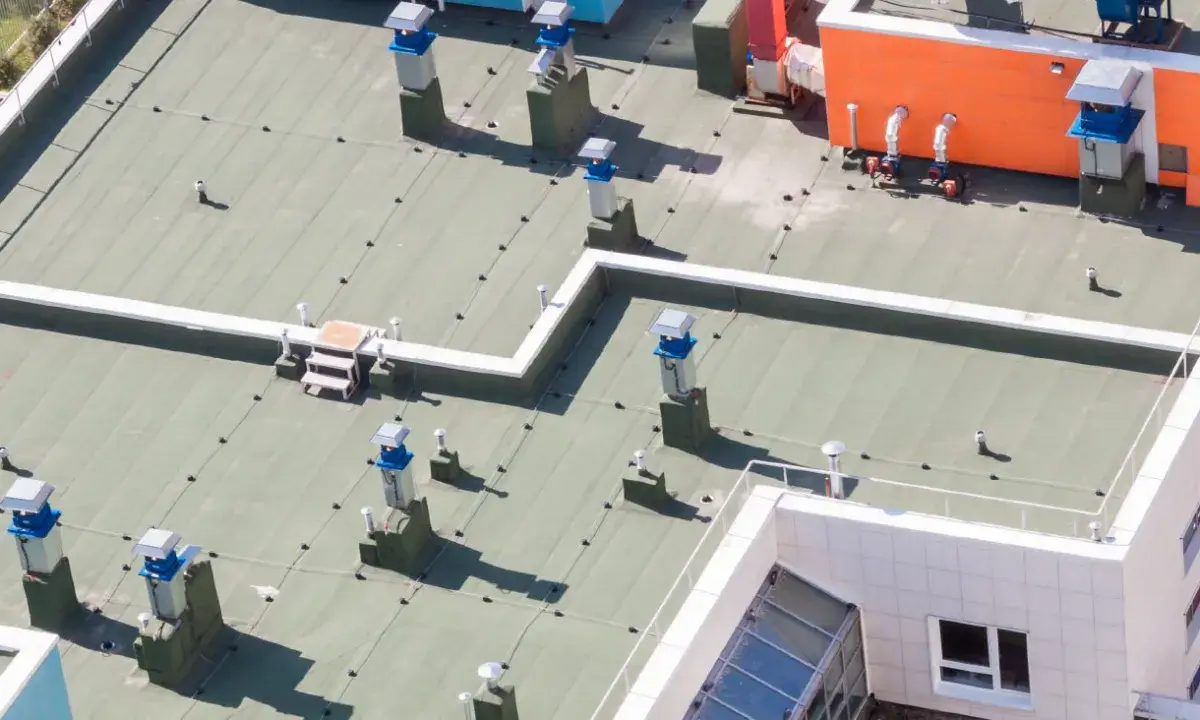
If you own or manage a commercial building in Middle Tennessee or North Georgia, your roof is a big investment — and the material you choose makes a real difference. Most commercial buildings have flat or low-slope roofs, which need different materials than a home’s pitched roof. Here’s a simple guide to the most common commercial flat roofing materials, and how they hold up in our climate.
TPO (Thermoplastic Polyolefin)
TPO is a single-ply membrane and one of the most popular choices today. It’s a white, reflective sheet that bounces sunlight away, which helps cut cooling costs during our hot summers. It resists heat, tears, and UV well, and it’s affordable. For many buildings here, it’s a strong all-around pick.
EPDM (Rubber Membrane)
EPDM is a durable rubber membrane known for lasting a long time and standing up to weather. It’s usually dark, so it absorbs heat instead of reflecting it — a plus in colder regions, but in our warm climate a reflective option often makes more sense for energy costs. Still, EPDM is tough and budget-friendly.
PVC (Polyvinyl Chloride)
PVC is another single-ply membrane, similar to TPO but a step up. It’s highly resistant to fire, chemicals, and grease, which makes it a favorite for restaurants and buildings with rooftop kitchen exhaust. It’s reflective like TPO and tends to last a long time. The trade-off is a higher upfront cost.
Modified Bitumen
Modified bitumen is a layered, asphalt-based system — a modern take on the old built-up roof. It handles foot traffic well, so it suits roofs that get serviced often. It comes in several layers for added protection.
Built-Up Roofing (BUR)
BUR is the classic tar-and-gravel system. It uses several layers of asphalt and fabric topped with gravel. It’s heavy and proven, with good protection and fire resistance, though newer membranes have largely taken its place.

Which Material Is Right for Your Building?
It depends on your budget, your roof’s design, how much foot traffic it gets, and your energy goals. We can walk you through the options and what works best in our climate. We serve commercial properties in Franklin, Kennesaw, and the nearby areas.
Contact us or call 678-345-1711 to talk through your commercial roof.